
Official Breathizen Supplement Facts: Label Transcript, Milligram Limits & Lab Questions
Every line of the Breathizen panel, what each one means under U.S. labeling rules, the milligram limits you can calculate from the order of names, and the lab results the seller has not published.
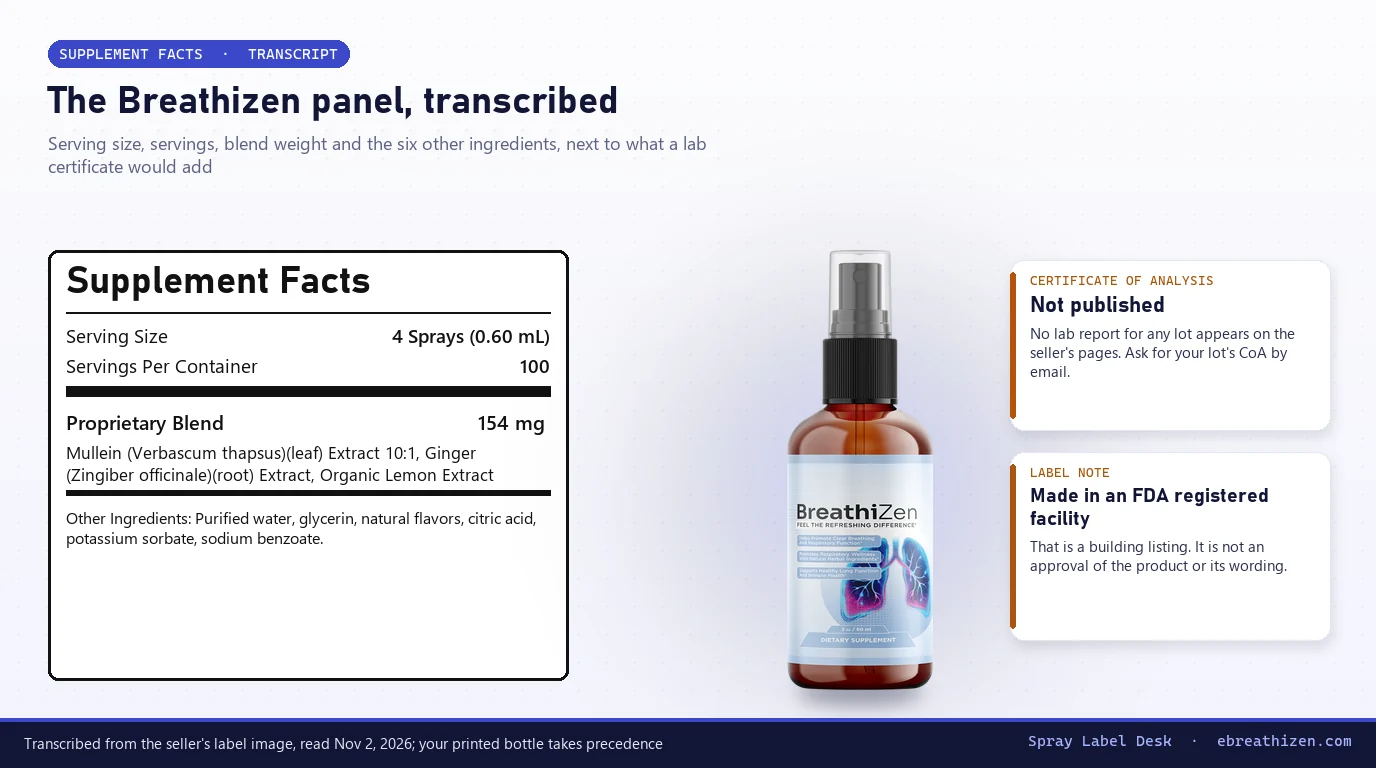
The panel, transcribed
Other Ingredients: Purified water, glycerin, natural flavors, citric acid, potassium sorbate, sodium benzoate.
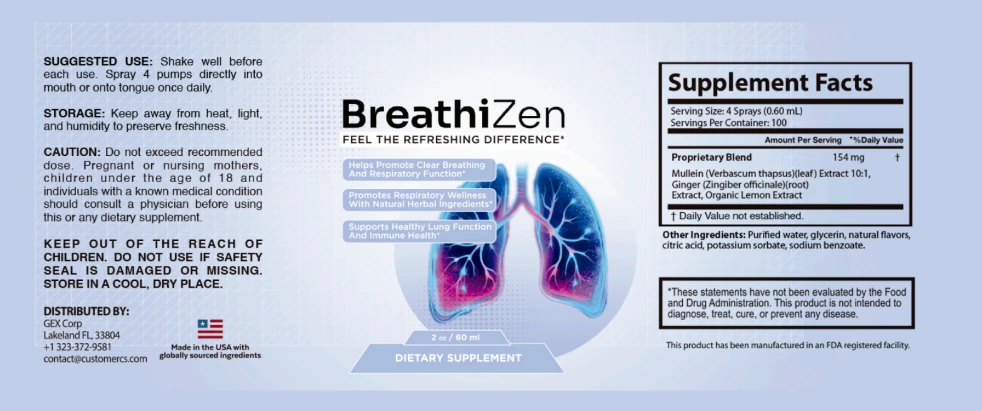
Seller's label artwork from forbreathizen.com, read November 2, 2026.
The transcript above copies every word and number in the Supplement Facts box of the label image the seller publishes. The side panels of the same artwork carry the directions ("Shake well before each use. Spray 4 pumps directly into mouth or onto tongue once daily."), storage ("Keep away from heat, light, and humidity to preserve freshness."), a caution block, the distributor line and two manufacturing statements. Each is read in turn below.
Reading the panel line by line
Serving Size: 4 Sprays (0.60 mL)
The serving is defined both by pump count and by volume, which is useful: it tells you each pump delivers about 0.15 mL. If your pump seems to deliver much more or less, the bottle will run out faster or slower than 100 days, and that is worth noting in your log.
Servings Per Container: 100
Sixty milliliters divided by 0.60 mL gives exactly 100. At the label's once-daily direction, one bottle is about 100 days of use, even though the seller sells each bottle as a "30 Day Supply." Expect a few servings lost to priming and to the last drops a pump cannot pick up.
%Daily Value and the dagger
Botanical extracts have no Daily Value, so the panel marks the blend with a dagger and the footnote "Daily Value not established." That is standard and correct[1].
Proprietary Blend 154 mg
The blend line is the heart of the panel and its main limitation. Federal rules let a manufacturer group dietary ingredients into a named blend and declare only the total weight, provided the ingredients are listed in descending order of weight[1]. Breathizen follows the rule: mullein, then ginger, then lemon. You learn the order but not the split.
Other Ingredients
Ingredients that are not dietary ingredients, the vehicle and preservatives, appear below the box. Here that is purified water, glycerin, natural flavors, citric acid, potassium sorbate and sodium benzoate. Glycerin is the one with a likely sensory effect of its own[7].
Blend arithmetic: what the order of names reveals
Because the three extracts must be listed heaviest first, simple arithmetic sets limits on each, even without the seller's numbers:
| Ingredient | Least possible | Most possible | What that means |
|---|---|---|---|
| Mullein leaf extract 10:1 (listed 1st) | 51.4 mg | 154 mg | About 0.5 to 1.5 g of dried leaf equivalent |
| Ginger root extract (listed 2nd) | 0 mg* | 77.0 mg | Under 4% of the 2 g/day asthma pilot dose |
| Organic lemon extract (listed 3rd) | 0 mg* | 51.3 mg | Flavor-level amounts |
*In theory a listed ingredient could be present at a trace; in practice all three are presumably meaningful shares. Mullein must be at least a third (51.4 mg rounded up), because it is the largest of three parts.
The most informative row is ginger. The only human airway trial of ginger used 2,000 mg a day[6]. Even at its theoretical maximum, one Breathizen serving holds 77 mg, under 4% of that. Mullein, as a 10:1 extract, is the most concentrated: if it occupied 100 mg, that would represent about 1 g of dried leaf, roughly the amount in a cup of traditional mullein tea, though Europe's tradition is built on the flower, not the leaf[5].
The statements around the panel
Structure-function claims and the asterisk
The front label says the spray "helps promote clear breathing and respiratory function," "promotes respiratory wellness with natural herbal ingredients" and "supports healthy lung function and immune health," each marked with an asterisk. Supplements may make claims about supporting normal structure or function, but only with the boxed disclaimer that FDA has not evaluated them and that the product is not intended to diagnose, treat, cure or prevent any disease[2]. Breathizen prints that disclaimer. Claims such as "treats asthma" or "clears infections" would cross into drug territory.
"This product has been manufactured in an FDA registered facility"
Food and supplement facilities register with FDA; registration is a listing that lets the agency know the plant exists and inspect it. It is not approval, certification or a quality grade, and FDA does not approve supplements before sale[3]. The facility is not named.
"Made in the USA with globally sourced ingredients"
Bottling and possibly blending happen in the U.S.; the botanicals are imported, from unstated countries. That is typical for mullein, ginger and lemon extracts.
Distributed by GEX Corp
The distributor is GEX Corp, Lakeland, Florida 33804, with the phone +1 323-372-9581 and email [email protected]. The website's terms page names GEX CORPORATION LLP as operator. Refunds go to a different Florida address in Largo.
Caution, storage and seal
The caution block reads, in substance: do not exceed the recommended dose; pregnant or nursing mothers, children under 18 and people with a known medical condition should consult a physician; keep out of reach of children; do not use if the safety seal is damaged or missing; store in a cool, dry place away from heat, light and humidity. Those are sensible, and NCCIH's general advice on using supplements wisely says the same[8].
Bottle math: 100 servings sold as a month
The panel and the order page disagree about time. The panel says 100 servings of 4 sprays, once daily. The order page labels a single bottle as a "30 Day Supply," two bottles as 60 days, three as 90 and six as 180. Both cannot describe the same use.
There are only three ways to reconcile them. Either people spray more than the label says (about 13 sprays a day would empty a bottle in a month), or the pump delivers far more than 0.15 mL per press, or the "30 Day Supply" wording is simply carried over from the seller's capsule products. The label explicitly says "do not exceed recommended dose," so we treat the first option as off the table, and we have no evidence for the second. The practical effect for you is good news on cost: at the label dose, one bottle is about three months of use, and the price per serving is a third of what the "monthly" framing implies.
Mark the date you open each bottle on its label. If a bottle empties in a few weeks while you use 4 sprays once a day, your pump is over-delivering or leaking; write to the seller, because you are not getting the serving the panel describes.
Storage, shelf life and keeping the pump clean
The label asks you to keep the bottle away from heat, light and humidity and store it in a cool, dry place. Amber bottles block some light, which helps protect plant compounds, and the citric acid plus sorbate and benzoate system protects the water and glycerin base against microbes between uses. A few habits help that system work:
- Replace the clear over-cap after each use so the nozzle stays clean and dry.
- Do not touch the nozzle to your tongue or lips; spray from just in front of the mouth.
- Do not leave the bottle in a hot car or on a sunny windowsill.
- Look at the liquid now and then. Cloudiness, strings, a sour or fermented smell or visible growth mean the bottle should be discarded and the seller told, with the lot code.
The label artwork we read does not show an expiry date, so check the printed bottle for a best-by or lot date and use opened bottles within the period it gives.
How this panel compares with better-disclosed products
Proprietary blends are legal and common, but they are a choice. Many herbal products list each extract with its own milligram amount and, for ginger, a standardized gingerol percentage. Against that standard, the Breathizen panel sits in the middle. It is better than funnel products that print no panel at all, because it gives a serving size, a servings count, a total blend weight, an ordered ingredient list and a distributor. It falls short of a fully disclosed label because you cannot convert it into a dose of any one plant.
If transparency is your priority, the two questions that would close most of the gap are short: "How many milligrams of each extract are in one 0.60 mL serving?" and "Is the ginger standardized to gingerols, and to what percentage?" Both are fair to ask, and the answers would let anyone compare Breathizen with the research doses directly.
Certificate of analysis: what is not on the label
A label tells you what the maker intends to put in the bottle. A certificate of analysis tells you what a lab found in one specific lot. Manufacturing rules require supplement makers to set specifications for identity, purity, strength and composition and to test against them[4], but they do not have to publish the results, and Breathizen does not.
We will not print numbers we have not seen. If a CoA matters to you, email the seller with the lot code from your bottle and ask for it while you are inside the refund window. A clear, prompt answer is itself useful information about the company.
Compare your bottle: a label worksheet
Labels change between production runs and some sellers ship more than one version. When your bottle arrives, compare it with the transcript here and tick each line. Anything different is a reason to email the seller before you start.
| Line | What we transcribed | Your bottle |
|---|---|---|
| Product name | BreathiZen, "Feel the refreshing difference" | |
| Net contents | 2 oz / 60 ml | |
| Serving size | 4 Sprays (0.60 mL) | |
| Servings per container | 100 | |
| Blend weight | 154 mg | |
| Blend ingredients, in order | Mullein leaf 10:1, ginger root, organic lemon | |
| Other ingredients | Purified water, glycerin, natural flavors, citric acid, potassium sorbate, sodium benzoate | |
| Distributor | GEX Corp, Lakeland FL 33804 | |
| Safety seal | Intact on arrival | |
| Lot code and date | Printed, legible |
If your panel lists bromelain or cordyceps, the safety notes on the ingredients page apply; if it lists a different blend weight, the arithmetic above changes with it. Ginger's known side effects are the same either way[9].
Questions on this topic
What is the serving size of Breathizen?
Four sprays, equal to 0.60 mL, taken once daily directly into the mouth or onto the tongue, according to the Supplement Facts panel.
How many servings are in a bottle of Breathizen?
One hundred. The bottle holds 2 fl oz (60 mL), and 60 divided by 0.60 is 100, so a bottle lasts about 100 days at the label dose.
Why does the label not show how much of each herb is inside?
Because the three extracts are declared as a proprietary blend. Federal rules allow a single total weight, here 154 mg, as long as the ingredients are listed from heaviest to lightest.
Is Breathizen third-party tested?
The seller does not publish any third-party lab results or certificate of analysis. The label states only that it is manufactured in an FDA registered facility, which is a registration, not a test.
Who makes Breathizen?
The label names GEX Corp of Lakeland, Florida, as distributor and says the product is made in the USA with globally sourced ingredients. The actual manufacturing facility is not named.
Records linked from this page
Each link opens the original record. The studies tested single ingredients at their own doses and routes; none tested the Breathizen spray or its 154 mg blend.
- 1Electronic Code of Federal Regulations. 21 CFR 101.36: Nutrition labeling of dietary supplements (proprietary blend rule in paragraph (c)). www.ecfr.gov/current/title-21/chapter-I/subchapter-B/part-101/subpart-C/section-101.36
- 2Electronic Code of Federal Regulations. 21 CFR 101.93: Certain types of statements for dietary supplements. www.ecfr.gov/current/title-21/chapter-I/subchapter-B/part-101/subpart-F/section-101.93
- 3U.S. Food and Drug Administration. Questions and Answers on Dietary Supplements. www.fda.gov/food/information-consumers-using-dietary-supplements/questions-and-answers-dietary-supplements
- 4Electronic Code of Federal Regulations. 21 CFR Part 111: Current Good Manufacturing Practice for dietary supplements. www.ecfr.gov/current/title-21/chapter-I/subchapter-B/part-111
- 5European Medicines Agency, Committee on Herbal Medicinal Products. Verbasci flos (mullein flower): herbal medicinal product summary and monograph. www.ema.europa.eu/en/medicines/herbal/verbasci-flos
- 6Emala CW, Saroya TK, Miao Y, Wang S, Sang S, DiMango EA. Low-dose oral ginger improves daily symptom scores in asthma. Pharmaceuticals (Basel). 2024;17(12):1651. pubmed.ncbi.nlm.nih.gov/39770492/
- 7Eccles R, Mallefet P. Soothing properties of glycerol in cough syrups for acute cough due to common cold. Pharmacy (Basel). 2017;5(1):4. pubmed.ncbi.nlm.nih.gov/28970416/
- 8National Center for Complementary and Integrative Health. Using Dietary Supplements Wisely. www.nccih.nih.gov/health/using-dietary-supplements-wisely
- 9National Center for Complementary and Integrative Health. Ginger: Usefulness and Safety. www.nccih.nih.gov/health/ginger
Run a fair 60-day Breathizen trial
The seller's checkout takes the order. Before the first morning spray, jot down how your chest, throat and stairs feel on an ordinary day, keep every inhaler and plan exactly as prescribed, save the confirmation email, and if nothing worth paying for has changed by week seven, email the refund request while the window is still open.