
Breathizen Ingredients: Mullein, Ginger, Lemon, Milligram Limits & Research
Three botanicals share one 154 mg blend in every 4-spray serving. Here is what each one is, how much of the blend it can occupy, what has been studied in people, and which sales-page ingredients never made it onto the panel.
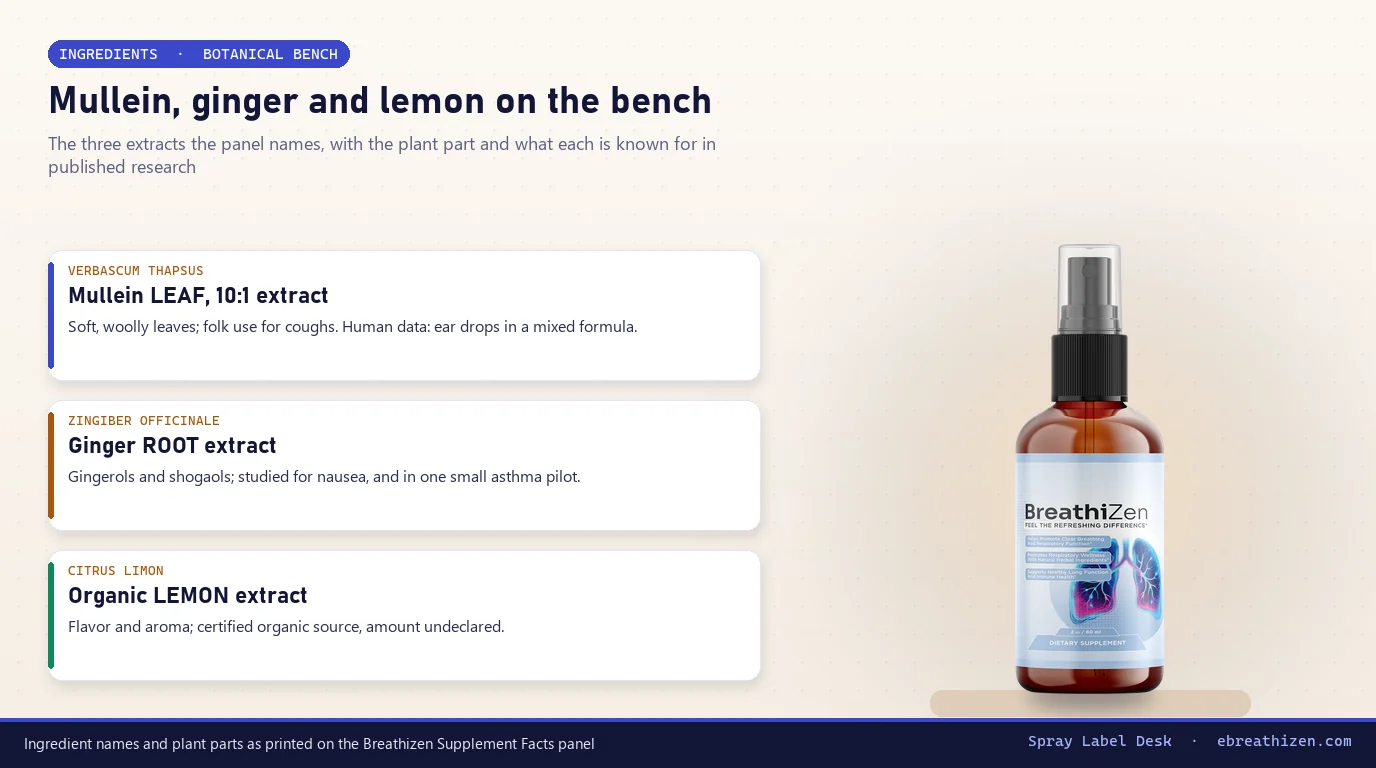
How to read the Breathizen ingredient list
The Breathizen panel names nine ingredients in two groups. Three botanical extracts sit inside a single "Proprietary Blend" with a combined weight of 154 mg per 4-spray serving. Six more are listed under "Other Ingredients," which is where the label puts the liquid base and the preservatives. Nothing else is declared: no vitamins with a percent Daily Value, no standardized marker compounds, no allergen statement.
The blend format matters more than it looks. Under federal labeling rules, a proprietary blend may list a single total weight, but its components must appear in descending order of predominance by weight[1]. That one rule lets us bound the amounts the seller does not print. Mullein is listed first, so it is the largest share: at least a third of the blend, 51.3 mg or more. Ginger is second, so it can never exceed half of 154 mg, or 77 mg. Lemon is last, so it is the smallest share, 51.3 mg at most. Those are ceilings and floors, not measurements, but they are more than the sales page offers.
A second rule of thumb: nothing in the blend is standardized. The panel does not say what percentage of gingerols the ginger delivers or which mullein compounds are measured. Two bottles from two lots can be "the same formula" and still differ in potency, which is normal for whole-plant extracts and is exactly what a certificate of analysis would clarify.
Mullein leaf extract 10:1 (Verbascum thapsus)
Common or great mullein is a tall biennial weed of roadsides and dry fields across Europe, Asia and North America, recognizable by its soft, grey-green, woolly leaves and a spike of yellow flowers in its second year. Both the leaves and the flowers have been used medicinally for centuries, most famously as a tea or smoke for coughs and chest complaints[2].
What is in the leaf
Reviews of the plant's chemistry list mucilage (the slippery polysaccharides that make a tea feel soothing), saponins, flavonoids, iridoid glycosides such as aucubin and catalpol, and phenylethanoid glycosides, of which verbascoside is the best studied[3][4]. Mucilage and saponins are the compounds most often linked to the traditional "expectorant" and soothing reputation.
What "10:1" means
A 10:1 extract is made by concentrating about ten parts of dried leaf into one part of extract. If mullein makes up, say, 70 mg of the blend, that corresponds to roughly 700 mg of dried leaf. The label does not say which solvent was used (water, alcohol or glycerin), and solvent decides which compounds end up in the extract: water pulls mucilage, alcohol pulls more of the phenolics.
What the research shows
Laboratory work finds antibacterial activity against several common bacteria[5], anti-inflammatory effects of verbascoside in human immune cells in culture[6] and antiviral activity of a methanol extract against a herpes-family animal virus in cells[7]. These results describe what an extract does in a dish at controlled concentrations. They do not establish that a swallowed dose reaches the airways, or reaches them at that strength.
The human data are thin and indirect. Two Israeli pediatric studies used ear drops containing mullein together with garlic, calendula and St John's wort in olive oil for ear pain in otitis media[8][9]. Useful for that question, but not for breathing, and not for an oral dose. We found no randomized trial of oral mullein for cough, congestion or lung function.
Leaf versus flower
The European Medicines Agency's herbal committee has a monograph for mullein flower (Verbasci flos), accepting it as a traditional herbal medicine to relieve sore throat associated with dry cough and cold, on the basis of long-standing use rather than clinical trials[10]. Breathizen uses the leaf, which is not covered by that monograph. The two parts overlap chemically, but they are not interchangeable in regulatory terms.
Safety
Mullein has a very low reported toxicity at food and tea levels. The practical hazard in home use is the fine leaf hairs, which irritate the throat if a tea is not strained; an extract in a filtered liquid avoids that. People allergic to plants in the figwort family should be cautious, though such allergies are rare.
Ginger root extract (Zingiber officinale)
Ginger is the rhizome of a tropical plant and one of the most studied culinary herbs in the world. Its warmth comes from gingerols in the fresh root and shogaols, which form when ginger is dried or heated. A review that pooled 109 randomized trials found the most consistent human benefits for nausea and vomiting, with some signals for inflammation markers and metabolic measures[11]. Pregnancy nausea is among the best-supported uses[17].
The airway research
Ginger is the only Breathizen ingredient with airway-specific mechanistic work in human tissue. Researchers at Columbia University showed that ginger extract and the purified compounds [6]-gingerol, [8]-gingerol and [6]-shogaol rapidly relaxed precontracted airway smooth muscle from humans and guinea pigs, by changing how the muscle cells handle calcium[12]. In mice sensitized to an allergen, an ethanolic ginger extract reduced the Th2 immune response and airway inflammation that model allergic asthma[13]. Fresh ginger also showed activity against respiratory syncytial virus in human respiratory cell lines[14]. Broader reviews describe antioxidant and anti-inflammatory effects across many systems[16].
The first human airway trial followed in 2024. Thirty-two adults with mild-to-moderate, poorly controlled asthma took either 1 g of ginger twice daily or placebo for two months while staying on their usual medicines. Exhaled nitric oxide and blood eosinophils did not change, but three separate measures of daily symptom control improved by day 28, and some asthma-related cytokines shifted[15]. The authors called it a first demonstration and asked for larger studies.
Putting the Breathizen dose in context
The asthma pilot used 2,000 mg a day of a ginger supplement by mouth. Because ginger is listed second in Breathizen's 154 mg blend, one serving holds 77 mg at the very most, under 4% of the pilot's daily amount, and probably much less. Breathizen is not the dose that was tested, and no one should expect the trial's result from it.
Traditional and regulatory status
In Europe, powdered ginger has "well-established use" status for preventing motion-sickness nausea, while relief of common-cold symptoms is accepted on traditional use only[19].
Safety
NCCIH notes that ginger has been used safely in many studies, and that oral ginger can cause abdominal discomfort, heartburn, diarrhea and mouth and throat irritation[20]. A systematic review found mixed evidence on whether ginger affects platelet aggregation in people[18], but it remains a routine caution with anticoagulants, antiplatelet drugs and upcoming surgery. Ask a pharmacist if any of those apply.
Organic lemon extract (Citrus limon)
Lemon is the last and smallest ingredient in the blend. A lemon extract typically contributes citric acid, the aroma compound limonene, flavonoids such as hesperidin and a little vitamin C. "Organic" refers to how the lemons were grown and certified, not to potency.
In a mouth spray, lemon's main job is almost certainly flavor: it balances the earthy mullein and the heat of ginger and makes the dose pleasant enough to repeat daily. The panel declares no vitamin C content, and with lemon capped at about 51 mg of extract per serving, any vitamin C is small. For comparison, the Cochrane review of vitamin C and colds looked at regular supplementation of at least 200 mg a day and found a modest reduction in cold duration in the general population, not prevention[21].
Citrus extracts are well tolerated. The acidity of lemon plus the added citric acid can sting if you have mouth ulcers, cracked lips or a raw throat; if that happens, aim the sprays at the middle of the tongue rather than the cheeks.
The base and the preservatives
Most of each 0.60 mL serving is not botanical extract at all. The panel's "Other Ingredients" describe the vehicle that carries the blend and keeps it stable for months in a bottle that is opened every day.
- Purified water. The solvent for everything else.
- Glycerin. A sweet, viscous liquid that gives body, taste and moisture-holding. In cough research it is considered a major reason syrups soothe: it lubricates, coats and acts as a demulcent[22], and sweetness itself seems to quiet cough through brain-stem pathways[23]. For many users this is the part of Breathizen they will actually feel.
- Natural flavors. Unspecified flavor compounds, usually citrus or mint notes in products like this.
- Citric acid. Sets the acidity, which helps the preservatives work and adds tartness.
- Potassium sorbate and sodium benzoate. Standard food preservatives that prevent mold and bacterial growth in water-based products. Both are permitted in beverages and syrups at far higher amounts than 0.60 mL of spray can carry.
There are no sugars, sweeteners, alcohol or dyes on the panel. People avoiding benzoates for a diagnosed sensitivity should note the sodium benzoate.
Ingredients named on the sales page but not on the panel
The seller's sales page describes a five-ingredient formula. It adds two ingredients to the three on the panel:
Bromelain powder
Bromelain is a group of protein-digesting enzymes from pineapple stems. A 12-patient open-label pilot in chronic rhinosinusitis used 500 FIP tablets, averaging 3,000 FIP units a day for three months, and reported better symptom scores[24]; a German observational study of children with acute sinusitis reported faster recovery on bromelain[25]. NCCIH's summary is that there is not enough high-quality research to recommend oral bromelain for sinusitis, and that it is generally well tolerated apart from stomach upset[26]. People allergic to pineapple, latex or papain, and anyone on blood thinners, should avoid it.
Organic Cordyceps militaris fruit extract
Cordyceps militaris is a cultivated mushroom used as an "adaptogen." In 28 young adults, a 4 g daily mushroom blend containing it improved some high-intensity exercise measures after three weeks[27]. That is exercise tolerance, not lung function. Memorial Sloan Kettering notes that cordyceps may increase the effects of anticoagulant and diabetes drugs[28].
Which list is right?
The printed Supplement Facts panel is the legally binding ingredient statement, and the panel we transcribed lists only mullein, ginger and lemon. The same sales page also contains a full ingredient section for an unrelated weight product (green tea, green coffee, L-carnitine, L-theanine, chromium and vitamin D3), which tells us the copy was adapted from another funnel. Read the panel on the bottle you receive; if it differs from ours, the bottle wins, and the safety notes above apply to whatever it lists.
Ingredient matrix: role, evidence and caution
| Ingredient | Share of the serving | Best human evidence | Main caution |
|---|---|---|---|
| Mullein leaf extract 10:1 | Largest share of the blend (listed first) | Lab studies; ear drops in a herbal mix | Very low reported toxicity; unstrained leaf hairs irritate |
| Ginger root extract | Middle share, 77 mg at most | 109-RCT review (nausea); 32-person asthma pilot at 2 g/day | Heartburn, mouth irritation; ask first with blood thinners |
| Organic lemon extract | Smallest share, 51 mg at most | No breathing trials; vitamin C trials at 200 mg+ | Citrus allergy is rare but possible |
| Glycerin (base) | Several hundred mg of the liquid | Reviews on demulcent action in cough syrups | Generally recognized as safe in food |
| Citric acid, sorbate, benzoate | Small preservative amounts | Food-additive safety data | May sting mouth ulcers; benzoate sensitivity |
| Bromelain (sales page only) | Not on the panel | Small sinus studies at 3,000 FIP/day | Pineapple allergy, bleeding caution |
| Cordyceps militaris (sales page only) | Not on the panel | One exercise trial at 4 g/day | Bleeding and diabetes-drug cautions |
Read across the rows and a pattern appears: the ingredients with the most interesting science (ginger, bromelain) are either present at a small fraction of the studied dose or not on the panel at all, while the ingredient with the largest share (mullein) has the least human evidence. That is common in botanical blends, and it is the strongest argument for treating Breathizen as a soothing routine rather than a targeted therapy.
What the ingredient list does not tell you
- Per-extract amounts. Only the 154 mg total is printed; the bounds above come from the descending-order rule.
- Standardization. No gingerol percentage and no marker compound for mullein.
- Extraction solvent. Water, alcohol or glycerin extraction changes the compounds you get.
- Source and testing. "Globally sourced ingredients" with no country, supplier or lab named.
- Allergen statement. None printed; the ingredients themselves are low-allergen, but cross-contact in the facility is not addressed.
Each of these is a reasonable question for the seller. Write to them before your 60 days run out, and keep the reply with your order email.
Questions on this topic
What are the active ingredients in Breathizen?
Three botanical extracts in one 154 mg proprietary blend per 4-spray serving: mullein leaf extract 10:1, ginger root extract and organic lemon extract, listed in that order.
How much ginger is in Breathizen?
The label does not say. Because ginger is listed second in a 154 mg blend that must be ordered by weight, it can be 77 mg at most per serving, and is probably less.
Does Breathizen contain bromelain or cordyceps?
The Supplement Facts panel we transcribed does not list them, although the sales page describes both. Check the panel on your own bottle; if they appear there, read the cautions above.
Is mullein safe to take every day?
Mullein has a very low reported toxicity at the amounts used in teas and extracts, and Breathizen's share is under 154 mg. Long-term daily safety has not been studied in trials, so pregnant, nursing and medically complex users should ask first.
Does Breathizen contain sugar or alcohol?
No sugar, sweetener or alcohol is listed. The sweetness comes from glycerin, and the liquid is preserved with citric acid, potassium sorbate and sodium benzoate.
Records linked from this page
Each link opens the original record. The studies tested single ingredients at their own doses and routes; none tested the Breathizen spray or its 154 mg blend.
- 1Electronic Code of Federal Regulations. 21 CFR 101.36: Nutrition labeling of dietary supplements (proprietary blend rule in paragraph (c)). www.ecfr.gov/current/title-21/chapter-I/subchapter-B/part-101/subpart-C/section-101.36
- 2Turker AU, Gurel E. Common mullein (Verbascum thapsus L.): recent advances in research. Phytother Res. 2005;19(9):733-739. pubmed.ncbi.nlm.nih.gov/16222647/
- 3Gupta A, Atkinson AN, Pandey AK, Bishayee A. Health-promoting and disease-mitigating potential of Verbascum thapsus L. (common mullein): a review. Phytother Res. 2022;36(4):1507-1522. pubmed.ncbi.nlm.nih.gov/35088467/
- 4Blanco-Salas J, Hortigón-Vinagre MP, Morales-Jadán D, Ruiz-Téllez T. Searching for scientific explanations for the uses of Spanish folk medicine: a review on the case of mullein (Verbascum, Scrophulariaceae). Biology (Basel). 2021;10(7):618. pubmed.ncbi.nlm.nih.gov/34356473/
- 5Turker AU, Camper ND. Biological activity of common mullein, a medicinal plant. J Ethnopharmacol. 2002;82(2-3):117-125. pubmed.ncbi.nlm.nih.gov/12241986/
- 6Speranza L, Franceschelli S, Pesce M, et al. Antiinflammatory effects in THP-1 cells treated with verbascoside. Phytother Res. 2010;24(9):1398-1404. pubmed.ncbi.nlm.nih.gov/20812283/
- 7Escobar FM, Sabini MC, Zanon SM, Tonn CE, Sabini LI. Antiviral effect and mode of action of methanolic extract of Verbascum thapsus L. on pseudorabies virus (strain RC/79). Nat Prod Res. 2012;26(17):1621-1625. pubmed.ncbi.nlm.nih.gov/21999656/
- 8Sarrell EM, Mandelberg A, Cohen HA. Efficacy of naturopathic extracts in the management of ear pain associated with acute otitis media. Arch Pediatr Adolesc Med. 2001;155(7):796-799. pubmed.ncbi.nlm.nih.gov/11434846/
- 9Sarrell EM, Cohen HA, Kahan E. Naturopathic treatment for ear pain in children. Pediatrics. 2003;111(5 Pt 1):e574-e579. pubmed.ncbi.nlm.nih.gov/12728112/
- 10European Medicines Agency, Committee on Herbal Medicinal Products. Verbasci flos (mullein flower): herbal medicinal product summary and monograph. www.ema.europa.eu/en/medicines/herbal/verbasci-flos
- 11Anh NH, Kim SJ, Long NP, et al. Ginger on human health: a comprehensive systematic review of 109 randomized controlled trials. Nutrients. 2020;12(1):157. pubmed.ncbi.nlm.nih.gov/31935866/
- 12Townsend EA, Siviski ME, Zhang Y, et al. Effects of ginger and its constituents on airway smooth muscle relaxation and calcium regulation. Am J Respir Cell Mol Biol. 2013;48(2):157-163. pubmed.ncbi.nlm.nih.gov/23065130/
- 13Khan AM, Shahzad M, Raza Asim MB, et al. Zingiber officinale ameliorates allergic asthma via suppression of Th2-mediated immune response. Pharm Biol. 2015;53(3):359-367. pubmed.ncbi.nlm.nih.gov/25420680/
- 14Chang JS, Wang KC, Yeh CF, Shieh DE, Chiang LC. Fresh ginger (Zingiber officinale) has anti-viral activity against human respiratory syncytial virus in human respiratory tract cell lines. J Ethnopharmacol. 2013;145(1):146-151. pubmed.ncbi.nlm.nih.gov/23123794/
- 15Emala CW, Saroya TK, Miao Y, Wang S, Sang S, DiMango EA. Low-dose oral ginger improves daily symptom scores in asthma. Pharmaceuticals (Basel). 2024;17(12):1651. pubmed.ncbi.nlm.nih.gov/39770492/
- 16Mashhadi NS, Ghiasvand R, Askari G, et al. Anti-oxidative and anti-inflammatory effects of ginger in health and physical activity: review of current evidence. Int J Prev Med. 2013;4(Suppl 1):S36-S42. pubmed.ncbi.nlm.nih.gov/23717767/
- 17Viljoen E, Visser J, Koen N, Musekiwa A. A systematic review and meta-analysis of the effect and safety of ginger in the treatment of pregnancy-associated nausea and vomiting. Nutr J. 2014;13:20. pubmed.ncbi.nlm.nih.gov/24642205/
- 18Marx W, McKavanagh D, McCarthy AL, et al. The effect of ginger (Zingiber officinale) on platelet aggregation: a systematic literature review. PLoS One. 2015;10(10):e0141119. pubmed.ncbi.nlm.nih.gov/26488162/
- 19European Medicines Agency, Committee on Herbal Medicinal Products. Zingiberis rhizoma (ginger): herbal medicinal product summary and monograph. www.ema.europa.eu/en/medicines/herbal/zingiberis-rhizoma
- 20National Center for Complementary and Integrative Health. Ginger: Usefulness and Safety. www.nccih.nih.gov/health/ginger
- 21Hemilä H, Chalker E. Vitamin C for preventing and treating the common cold. Cochrane Database Syst Rev. 2013;(1):CD000980. pubmed.ncbi.nlm.nih.gov/23440782/
- 22Eccles R, Mallefet P. Soothing properties of glycerol in cough syrups for acute cough due to common cold. Pharmacy (Basel). 2017;5(1):4. pubmed.ncbi.nlm.nih.gov/28970416/
- 23Eccles R. Mechanisms of the placebo effect of sweet cough syrups. Respir Physiol Neurobiol. 2006;152(3):340-348. pubmed.ncbi.nlm.nih.gov/16326149/
- 24Büttner L, Achilles N, Böhm M, Shah-Hosseini K, Mösges R. Efficacy and tolerability of bromelain in patients with chronic rhinosinusitis: a pilot study. B-ENT. 2013;9(3):217-225. pubmed.ncbi.nlm.nih.gov/24273953/
- 25Braun JM, Schneider B, Beuth HJ. Therapeutic use, efficiency and safety of the proteolytic pineapple enzyme Bromelain-POS in children with acute sinusitis in Germany. In Vivo. 2005;19(2):417-421. pubmed.ncbi.nlm.nih.gov/15796206/
- 26National Center for Complementary and Integrative Health. Bromelain: Usefulness and Safety. www.nccih.nih.gov/health/bromelain
- 27Hirsch KR, Smith-Ryan AE, Roelofs EJ, Trexler ET, Mock MG. Cordyceps militaris improves tolerance to high-intensity exercise after acute and chronic supplementation. J Diet Suppl. 2017;14(1):42-53. pubmed.ncbi.nlm.nih.gov/27408987/
- 28Memorial Sloan Kettering Cancer Center, About Herbs. Cordyceps. www.mskcc.org/cancer-care/integrative-medicine/herbs/cordyceps
Run a fair 60-day Breathizen trial
The seller's checkout takes the order. Before the first morning spray, jot down how your chest, throat and stairs feel on an ordinary day, keep every inhaler and plan exactly as prescribed, save the confirmation email, and if nothing worth paying for has changed by week seven, email the refund request while the window is still open.